TempRx Series | Part 11 of 12
So far, we’ve treated heat and cold as separate interventions. Sauna for cellular repair and cardiovascular health. Cold for neurochemical activation and metabolic boost.
But what if you did both?
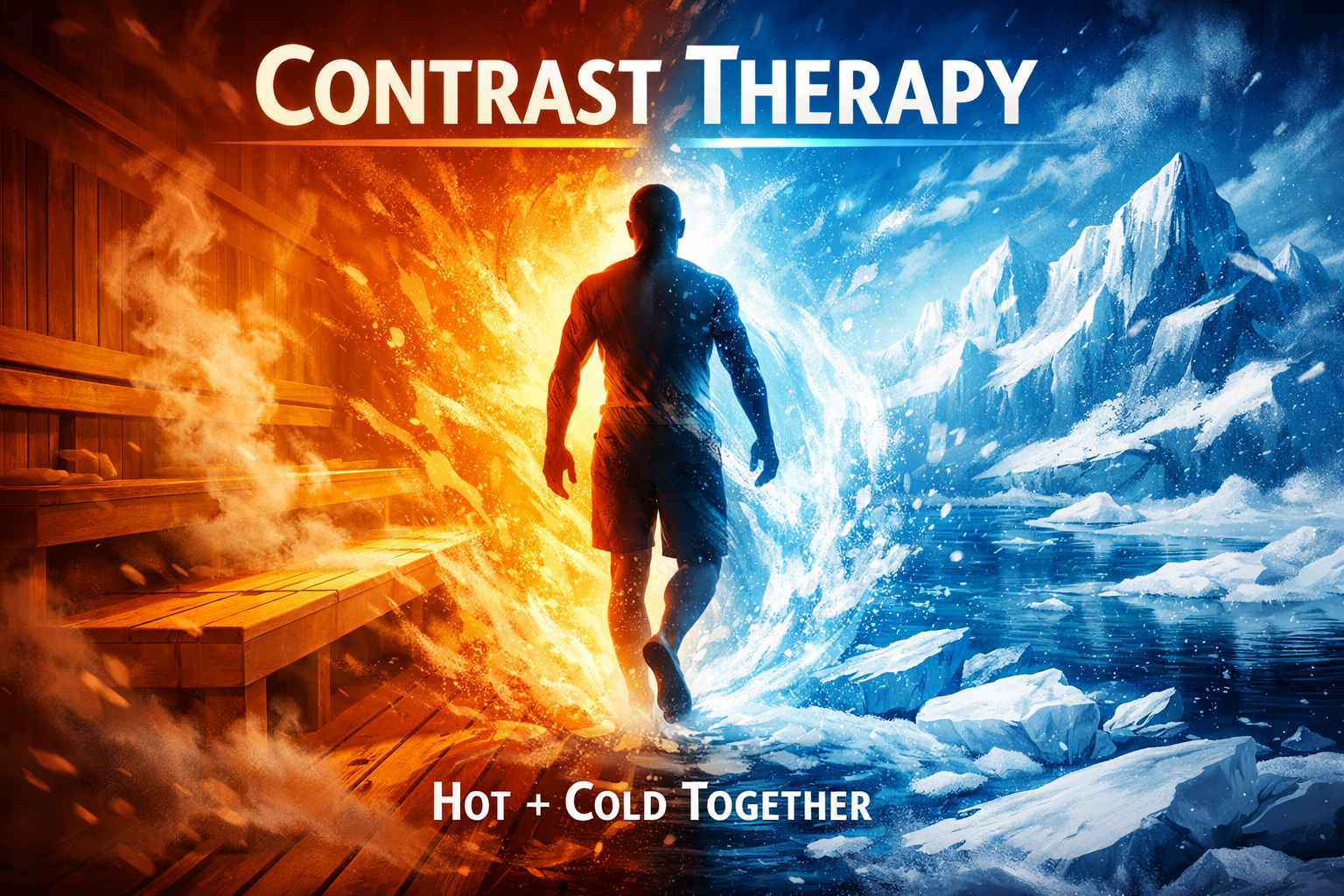
Contrast therapy — alternating between hot and cold — isn’t a modern biohack. It’s ancient practice. Roman baths had hot and cold pools for a reason. Scandinavians have paired saunas with ice lakes for centuries. Japanese onsen culture includes cold rinses between hot soaks.
These traditions weren’t based on randomized controlled trials. They were based on something simpler: it works. People feel better. They recover faster. They sleep deeper.
Now the science is catching up, and we’re beginning to understand why combining hot and cold produces benefits beyond either alone.
The Logic of Contrast
Heat and cold trigger different adaptive responses:
Heat activates:
- Heat shock proteins (cellular repair)
- Cardiovascular conditioning
- Vasodilation (blood vessels expand)
- Parasympathetic tone (relaxation response)
- Growth hormone release
Cold activates:
- Cold shock proteins (neural protection)
- Norepinephrine and dopamine (alertness, mood)
- Vasoconstriction (blood vessels contract)
- Brown fat thermogenesis
- Sympathetic activation (stress response)
These aren’t just different — they’re often opposite. Heat relaxes blood vessels; cold constricts them. Heat promotes parasympathetic calm; cold triggers sympathetic alertness.

Contrast therapy forces your body to toggle rapidly between these states. Blood vessels dilate, then constrict, then dilate again. Your nervous system shifts from parasympathetic to sympathetic and back. The system gets a workout — not just from each individual stimulus, but from the transitions themselves.
The Vascular Pump Effect
One of the most tangible benefits of contrast therapy is what some call the “vascular pump.”
When you’re hot, blood vessels dilate and blood rushes to the periphery — your skin flushes, extremities warm. When you plunge into cold, vessels constrict rapidly, pushing blood back toward your core. Return to heat and vessels dilate again, blood rushes outward.
This cycling creates a pumping action that:
Enhances circulation. Blood moves more dynamically than with either stimulus alone. Peripheral tissues get flushed with fresh blood repeatedly.
Supports lymphatic drainage. The lymphatic system (which clears cellular waste) doesn’t have its own pump — it relies on muscle contraction and external pressure. The vascular cycling of contrast therapy assists lymphatic flow.
Reduces inflammation. The repeated vasoconstriction-vasodilation cycle may help clear inflammatory markers from tissues, potentially speeding recovery from exercise or injury.
Decreases muscle soreness. Athletes have used contrast therapy for recovery for decades. Research shows reduced delayed-onset muscle soreness (DOMS) compared to passive recovery.
Nervous System Training
Beyond the vascular effects, contrast therapy trains your autonomic nervous system to shift states efficiently.
Most people are stuck. Chronically stressed individuals live in sympathetic overdrive — always on alert, unable to fully relax. Others struggle with parasympathetic excess — low energy, poor stress response, difficulty mobilizing for challenges.
Healthy nervous system function requires the ability to shift smoothly between states: activate when needed, recover when safe. This flexibility is called autonomic balance or vagal tone.
Contrast therapy practices this shift explicitly. Hot triggers parasympathetic relaxation. Cold triggers sympathetic activation. Repeat. Your nervous system gets reps — transitioning between states under controlled conditions.

Over time, this may improve your baseline autonomic flexibility. Better able to relax when you want to. Better able to activate when you need to. Less stuck in either extreme.
What the Research Shows
Contrast therapy research spans athletic recovery, rehabilitation, and general wellness:
Athletic recovery:
- Multiple studies show contrast water therapy reduces perceived muscle soreness after intense exercise
- Some evidence of faster strength recovery compared to passive rest
- Widely used in professional sports — the anecdotal evidence from athletes is overwhelming, even where controlled studies are limited
Circulation and vascular health:
- Contrast bathing improves peripheral blood flow in studies on both healthy subjects and those with circulatory issues
- May benefit conditions involving poor circulation, though more research is needed
Inflammation and edema:
- Used in physical therapy for reducing swelling after injury
- The pumping action helps clear excess fluid from tissues
Mood and well-being:
- Combining sauna’s relaxation with cold’s neurochemical boost produces a distinctive post-session state: calm but alert, relaxed but energized
- Many practitioners describe this as the best they feel all day
The research base isn’t as deep as standalone sauna or cold immersion studies. But the combination has strong theoretical grounding (triggering complementary pathways) and consistent user experience (people love how it feels).
The Søberg Recommendation: End on Cold
Dr. Susanna Søberg’s research offers specific guidance for contrast therapy: end on cold.
Here’s the reasoning:
When you finish with heat, you feel warm and relaxed. Comfortable. But you’ve also suppressed the thermogenic response — your body doesn’t need to generate heat because you’ve provided it externally.
When you finish with cold, your body must rewarm itself. Brown fat activates. Thermogenesis kicks in. Calories burn to generate internal heat. This metabolic activation continues for some time after you exit the cold.
Ending on cold extends the metabolic benefits of your session. You get the heat shock proteins from sauna, the cold shock proteins from the plunge, AND the prolonged brown fat activation from self-rewarming.
This doesn’t mean you need to shiver for an hour. Gentle rewarming — putting on clothes, moving around, drinking something warm (not hot) — is fine. Just avoid blasting yourself with hot water immediately after cold, which short-circuits the thermogenic response.
Practical Contrast Protocols
There’s no single “right” way to do contrast therapy. Here are common approaches:
Classic Scandinavian:
- 15-20 minutes in sauna
- 1-3 minutes in cold water (lake, plunge, cold shower)
- Return to sauna for 10-15 minutes
- Repeat cold exposure
- End on cold
- Total session: 45-60 minutes with 2-3 cycles
Time-Efficient Version:
- 15 minutes in sauna
- 2-3 minutes cold plunge
- End on cold
- Total session: 20 minutes
Gym-Accessible Protocol:
- 15-20 minutes in steam room or sauna
- 3-5 minutes cold shower (as cold as available)
- Optional: return to heat for 10 minutes
- End on cold
- Total session: 25-35 minutes
Hot Tub + Cold Plunge:
- 20-30 minutes in hot tub
- 2-4 minutes cold plunge
- Return to hot tub for 10-15 minutes
- End on cold
- Total session: 40-50 minutes
Shower-Only Contrast:
- 3-4 minutes hot shower
- 1-2 minutes cold shower
- Repeat 3-4 cycles
- End on cold
- Total session: 15-20 minutes
The principles remain consistent: enough heat to trigger HSPs and vasodilation, enough cold to trigger CSPs and vasoconstriction, and end on cold to maximize metabolic benefit.
Timing and Frequency
When to do contrast therapy:
Post-workout is popular for recovery benefits. The circulation boost and inflammation reduction may speed muscle repair. However, some research suggests cold immersion immediately after strength training may blunt muscle growth — if hypertrophy is your primary goal, you might wait 4-6 hours or save contrast for non-lifting days.
Morning sessions provide an energizing start. The cold finish leaves you alert and activated for the day.
Evening sessions can work if you end the cold component early enough. The sauna portion promotes relaxation and may improve sleep, but intense cold too close to bedtime can be stimulating.
Rest days are ideal for longer contrast sessions focused on recovery and well-being rather than training optimization.
Frequency:
Contrast therapy can be done daily if desired, though 3-5 times per week is more common and sustainable. The cumulative benefits come from consistency over time, not heroic individual sessions.
Who Shouldn’t Do Contrast Therapy
The rapid cardiovascular shifts of contrast therapy add stress that some people should avoid:
- Uncontrolled hypertension — the blood pressure swings can be problematic
- Recent heart attack or unstable angina — too much cardiovascular stress
- Severe Raynaud’s disease — cold triggers painful vasoconstriction
- Pregnancy — extreme heat especially is contraindicated
- Open wounds or acute injuries — wait until healed
- During illness with fever — your body is already temperature-stressed
If you have cardiovascular conditions, consult your doctor before starting contrast therapy. The vascular demands are real.
For healthy individuals, contrast therapy is remarkably safe — humans have done it for millennia. Start conservatively, listen to your body, and progress gradually.
The Takeaway
Contrast therapy isn’t just doing both hot and cold — it’s leveraging the transition between them. The vascular pumping, the nervous system training, the combination of complementary stress responses.
Heat for repair. Cold for activation. The oscillation between them for circulatory and autonomic benefits neither provides alone.
The Scandinavians figured this out centuries ago. Sauna, then lake. Hot, then cold. Repeat. End cold.
Whether you have access to a traditional setup or you’re working with a gym steam room and cold shower, the principle applies. Alternate. Cycle. Let your body toggle between states.
It’s not about suffering through temperature extremes. It’s about training your physiology to be adaptable, resilient, and efficient.
Hot and cold aren’t opposites to choose between. They’re complements to combine.
Next up: Building Your Weekly Protocol — putting it all together into a sustainable practice that fits your life.
References:
- Søberg, S., et al. (2021). Altered brown fat thermoregulation and enhanced cold-induced thermogenesis in young, healthy, winter-swimming men. Cell Reports Medicine. https://www.cell.com/cell-reports-medicine/fulltext/S2666-3791(21)00266-4
- Cochrane, D.J. (2004). Alternating hot and cold water immersion for athlete recovery: a review. Physical Therapy in Sport. https://pubmed.ncbi.nlm.nih.gov/21048526/
- Bieuzen, F., et al. (2013). Contrast water therapy and exercise induced muscle damage: a systematic review and meta-analysis. PLOS ONE. https://journals.plos.org/plosone/article?id=10.1371/journal.pone.0062356
- Versey, N.G., et al. (2013). Water immersion recovery for athletes: effect on exercise performance and practical recommendations. Sports Medicine. https://pubmed.ncbi.nlm.nih.gov/23743793/
- Higgins, T.R., et al. (2017). Effects of Cold Water Immersion and Contrast Water Therapy for Recovery From Team Sport: A Systematic Review and Meta-analysis. Journal of Strength and Conditioning Research. https://pubmed.ncbi.nlm.nih.gov/27398917/
- Laukkanen, T., et al. (2018). Cardiovascular and Other Health Benefits of Sauna Bathing: A Review of the Evidence. Mayo Clinic Proceedings. https://www.mayoclinicproceedings.org/article/S0025-6196(18)30275-1/fulltext
- Mooventhan, A., & Nivethitha, L. (2014). Scientific evidence-based effects of hydrotherapy on various systems of the body. North American Journal of Medical Sciences. https://www.ncbi.nlm.nih.gov/pmc/articles/PMC4049052/