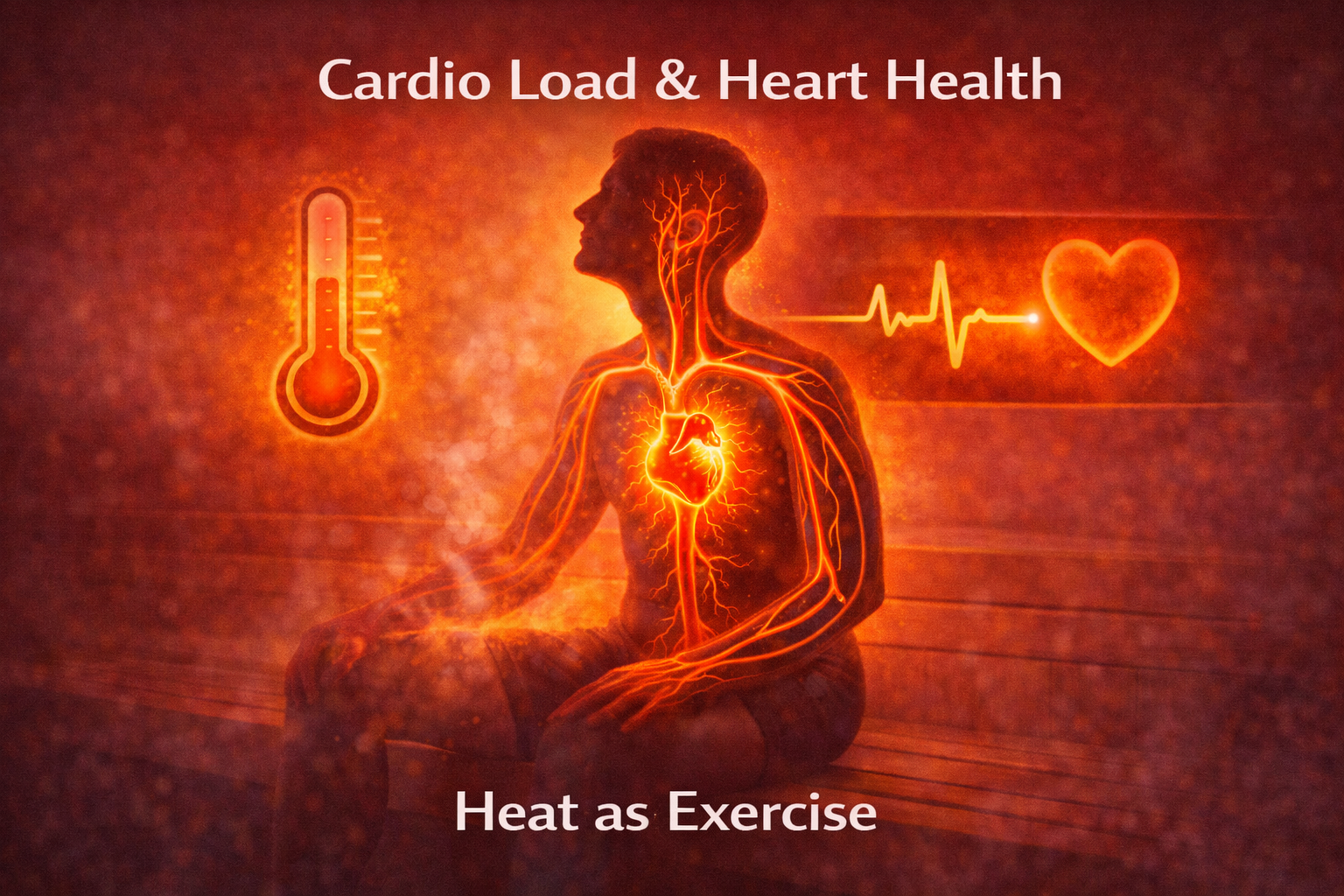
TempRx Series | Part 9 of 12
Here’s something that surprises people: sitting in a hot room can train your cardiovascular system.
Not as a replacement for exercise. But as a genuine physiological stimulus that makes your heart work, your blood vessels adapt, and your cardiovascular risk factors improve.
When Finnish researchers found that frequent sauna users had dramatically lower rates of heart disease and cardiovascular death, they weren’t just observing correlation. They were documenting the effects of repeated cardiovascular stress — the same basic principle that makes exercise good for your heart.
Heat is exercise for your circulatory system. And like exercise, the dose matters.
What Happens to Your Heart in Heat
Within minutes of entering a hot sauna, your cardiovascular system responds:
Heart rate increases. From a resting 60-80 bpm to 100-150 bpm, depending on temperature and individual response. That’s the range of moderate aerobic exercise — a brisk walk to a light jog.
Cardiac output rises. Your heart pumps more blood per minute. Stroke volume (blood per beat) and heart rate both increase to meet demand.
Blood pressure shifts. Initially, systolic pressure may rise slightly. Then blood vessels dilate dramatically, and both systolic and diastolic pressure typically fall. Post-sauna, blood pressure remains lower for hours.
Blood flow redistributes. Circulation to the skin increases dramatically — up to 50-70% of cardiac output — to facilitate heat dissipation. Your skin flushes. You turn red. Blood is rushing to the surface.

This is not passive relaxation. Your cardiovascular system is working. The heart muscle contracts more frequently and forcefully. Blood vessels expand and contract. The entire system is under controlled stress.
The Exercise Parallel
The comparison to exercise isn’t metaphorical — it’s physiological.
During moderate aerobic exercise:
- Heart rate: 100-150 bpm
- Cardiac output: increased
- Blood vessels: dilated
- Core temperature: elevated
- Sweating: profuse
During sauna bathing:
- Heart rate: 100-150 bpm
- Cardiac output: increased
- Blood vessels: dilated
- Core temperature: elevated
- Sweating: profuse
The mechanisms differ — exercise involves skeletal muscle contraction and metabolic demand, while sauna involves thermal regulation. But the cardiovascular load is remarkably similar.
This is why researchers describe sauna as a “cardiovascular exercise mimetic.” It produces exercise-like stress on the heart and blood vessels without the mechanical stress on joints, muscles, and connective tissue.
Who Benefits Most
The cardiovascular mimetic effect has important implications for specific populations:
People who can’t exercise traditionally. Injury, disability, severe obesity, chronic fatigue, post-surgical recovery — many conditions limit the ability to perform aerobic exercise. Sauna provides cardiovascular conditioning when other options aren’t available.
Elderly individuals. Age-related frailty, joint problems, and balance issues make vigorous exercise risky for many older adults. Sauna offers heart-healthy stress with minimal fall or injury risk.
Cardiac rehabilitation patients. Under medical supervision, heat therapy is being studied as a complement to traditional cardiac rehab. Some heart failure patients show improved outcomes with regular sauna use.
Athletes during recovery. On rest days or during deload periods, sauna maintains cardiovascular stimulus without adding training stress. Some endurance athletes use heat acclimation to improve performance.

None of this means sauna replaces exercise. Exercise builds muscle, bone density, coordination, and metabolic fitness in ways heat cannot. But for cardiovascular conditioning specifically, sauna offers a legitimate alternative stimulus.
The Vascular Training Effect
Beyond acute cardiovascular load, regular heat exposure trains your blood vessels to function better.
Endothelial function improves. The endothelium is the inner lining of blood vessels. Healthy endothelium produces nitric oxide, which signals vessels to dilate. Repeated heat exposure improves endothelial function, making blood vessels more responsive and flexible.
Arterial stiffness decreases. Stiff arteries are a major cardiovascular risk factor, contributing to high blood pressure and heart strain. Studies show regular sauna use reduces arterial stiffness.
Blood pressure lowers. Chronic sauna users have lower resting blood pressure than non-users. The effect is dose-dependent — more frequent use produces larger reductions.
A 2016 study by Brunt et al. found that 8 weeks of passive heat therapy (hot water immersion) in sedentary adults improved endothelial function and reduced arterial stiffness to a degree comparable to aerobic exercise training. Sitting in hot water produced vascular adaptations similar to jogging.
The Finnish Cardiovascular Data
The Kuopio study wasn’t just measuring all-cause mortality. It tracked specific cardiovascular outcomes:
Cardiovascular disease mortality:
- 4-7 sauna sessions/week: 50% reduction vs. 1 session/week
Sudden cardiac death:
- 4-7 sauna sessions/week: 63% reduction vs. 1 session/week
Fatal coronary heart disease:
- 4-7 sauna sessions/week: 48% reduction vs. 1 session/week
Stroke:
- Follow-up studies found similar dose-dependent reductions in stroke risk
These are not small effects. They rival or exceed the cardiovascular protection seen with statin medications, and they’re achieved through a behavioral intervention rather than pharmaceutical.
The mechanism is clear: repeated cardiovascular stress plus vascular training plus reduced inflammation plus improved risk factors (blood pressure, lipids, glucose handling) compound over years into dramatically lower disease risk.
Heat and Blood Pressure
Hypertension is the leading modifiable risk factor for cardiovascular disease. Anything that sustainably lowers blood pressure reduces heart attack and stroke risk.
Sauna consistently lowers blood pressure through multiple mechanisms:
Acute effect: During and immediately after sauna, blood vessels dilate, reducing resistance and lowering pressure. This persists for several hours post-session.
Chronic effect: Regular sauna users have lower baseline blood pressure. The vascular training effect — improved endothelial function, reduced arterial stiffness — creates lasting improvement.
Medication-like magnitude: Some studies show blood pressure reductions of 7-10 mmHg systolic with regular sauna use. That’s comparable to a low-dose blood pressure medication.
For people with mild hypertension, regular sauna use might reduce or delay the need for medication. For those already on medication, it may improve control. (Always coordinate with a physician — heat affects medication needs and tolerance.)
Cautions and Contraindications
Heat is cardiovascular stress. For most people, that’s beneficial. For some, it’s risky.
Talk to your doctor first if you have:
- Unstable angina or recent heart attack
- Severe aortic stenosis
- Uncontrolled blood pressure (very high or very low)
- Heart failure (though some research shows benefits under supervision)
- Recent stroke
- Arrhythmias that aren’t well-controlled
General safety principles:
- Hydrate aggressively. You lose substantial fluid through sweat. Dehydration thickens blood and stresses the heart. Drink before, during breaks, and after.
- Avoid alcohol. Alcohol plus sauna increases cardiac arrhythmia risk and impairs temperature regulation. The Finnish tradition of sauna beer is enjoyable but not without risk.
- Don’t overdo it. More is not always better. If you feel dizzy, lightheaded, or nauseous, get out. Don’t push through symptoms.
- Exit gradually. Standing up quickly after lying in heat can cause blood pressure drops and fainting. Sit up slowly, wait, then stand.
For healthy individuals, sauna is remarkably safe. The Finnish population has used saunas for generations with minimal adverse events. But respect the stress you’re placing on your system.
The Cardio Load Metric in TempRx
TempRx tracks “Cardio Load” as one of its heat metrics alongside HSP activation and longevity markers.
Cardio Load estimates the cardiovascular stress of your heat session based on temperature, humidity, and duration. Higher temperatures and longer durations produce greater cardiovascular load — more heart rate elevation, more vascular stress, more training stimulus.
This matters for two reasons:
Optimization: If you’re using sauna specifically for cardiovascular benefits, you want enough load to produce adaptation. A quick 5-minute session at moderate temperature may not hit the threshold.
Safety: If you have cardiovascular concerns, you want to avoid excessive load. Knowing where you fall on the spectrum helps calibrate your protocol.
The calculator doesn’t replace medical advice. But it gives you a framework for understanding what your body experiences during heat exposure.
The Takeaway
Sauna is cardiovascular training. Not a metaphor — actual physiological stress that makes your heart pump harder, your vessels dilate, and your circulatory system adapt.
The Finnish data demonstrates that regular heat exposure produces dramatic reductions in cardiovascular disease, sudden cardiac death, and stroke. The mechanisms — cardiovascular conditioning, vascular function improvement, blood pressure reduction, inflammation lowering — are well-understood.
For people who can’t exercise, sauna offers a genuine alternative. For people who can exercise, sauna offers a complement — additional cardiovascular stimulus on rest days, or a way to maintain conditioning during injury or travel.
Heat doesn’t replace exercise. But it supplements it in ways we’re only beginning to fully understand.
Your heart doesn’t know the difference between a hard run and a hard sauna session. It just knows it’s working.
Next up: BDNF & Mental Clarity — how cold exposure sharpens your brain and lifts your mood.
References:
- Laukkanen, T., et al. (2015). Association Between Sauna Bathing and Fatal Cardiovascular and All-Cause Mortality Events. JAMA Internal Medicine. https://jamanetwork.com/journals/jamainternalmedicine/fullarticle/2130724
- Laukkanen, T., et al. (2018). Cardiovascular and Other Health Benefits of Sauna Bathing: A Review of the Evidence. Mayo Clinic Proceedings. https://www.mayoclinicproceedings.org/article/S0025-6196(18)30275-1/fulltext
- Brunt, V.E., et al. (2016). Passive heat therapy improves endothelial function, arterial stiffness and blood pressure in sedentary humans. Journal of Physiology. https://physoc.onlinelibrary.wiley.com/doi/full/10.1113/JP272453
- Brunt, V.E., et al. (2016). Heated water-based passive heat therapy improves vascular function: A systematic review and meta-analysis. American Journal of Physiology. https://journals.physiology.org/doi/full/10.1152/ajpheart.00102.2016
- Kunutsor, S.K., et al. (2018). Sauna bathing reduces the risk of stroke in Finnish men and women. Neurology. https://n.neurology.org/content/90/22/e1937
- Lee, E., et al. (2018). Sauna exposure leads to improved arterial compliance: Findings from a non-randomised experimental study. European Journal of Preventive Cardiology. https://pubmed.ncbi.nlm.nih.gov/28617620/
- Gryka, D., et al. (2014). The effect of sauna bathing on lipid profile in young, physically active, male subjects. International Journal of Occupational Medicine and Environmental Health. https://pubmed.ncbi.nlm.nih.gov/25503891/