TempRx Series | Part 4 of 12
Everyone wants to know the minimum effective dose.
How little can I do and still get the benefits?
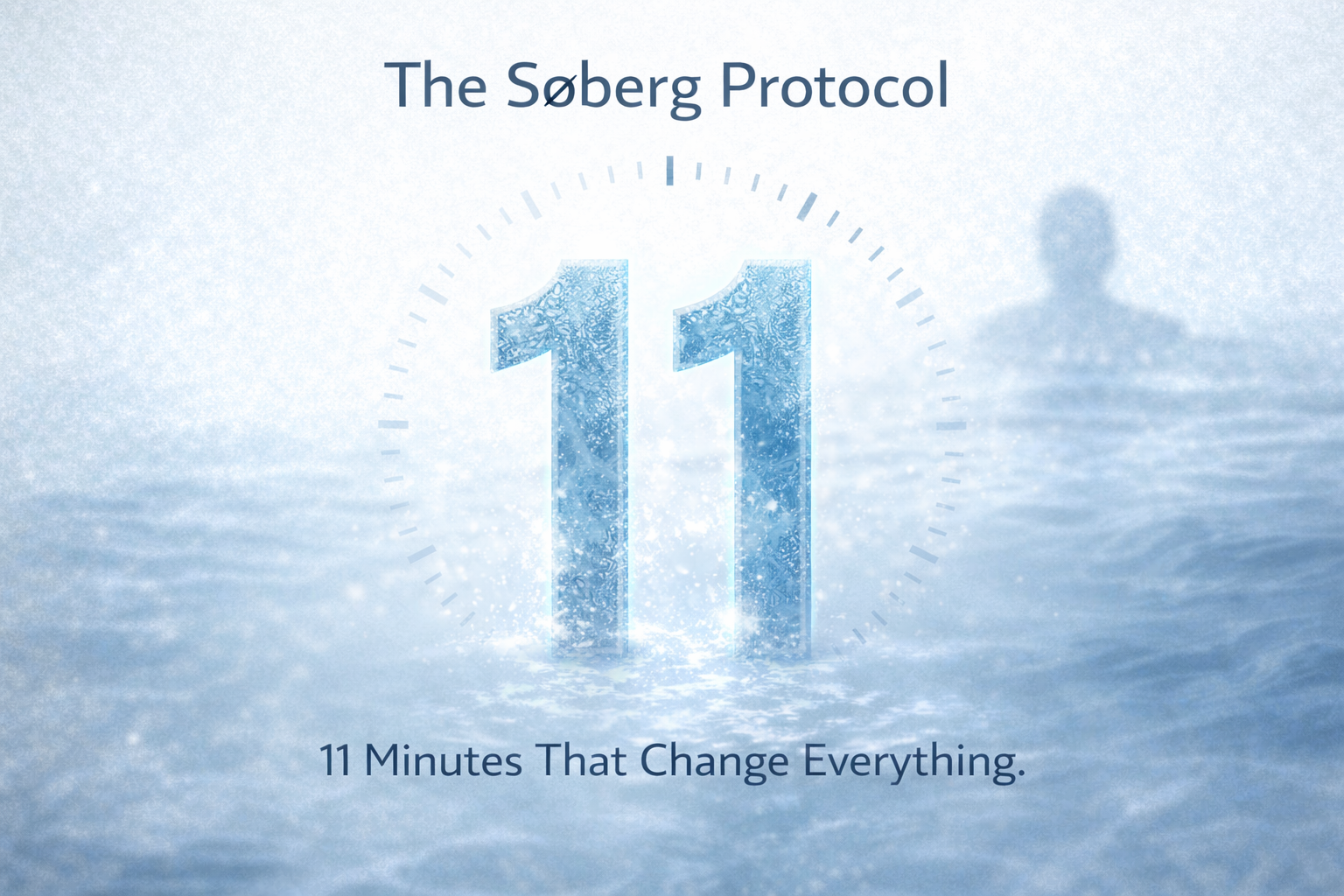
For cold exposure, we actually have an answer. And it comes from Dr. Susanna Søberg, a Danish researcher who analyzed dozens of cold exposure studies to find the threshold where benefits reliably appear.
The number: 11 minutes per week.
That’s it. Total. Not per session — per week.
Spread it however you want. Three 3-4 minute sessions. Five 2-minute dips. Daily 90-second cold showers. The research suggests that accumulating 11 minutes of cold exposure weekly is enough to produce meaningful increases in brown fat activity, norepinephrine response, and metabolic improvements.
No ice baths until you can’t feel your legs. No Wim Hof mountain expeditions. Just 11 minutes, distributed across your week.
Who Is Susanna Søberg?
Dr. Søberg is a metabolism researcher at the University of Copenhagen who studies how temperature exposure affects human physiology — particularly brown fat, thermogenesis, and metabolic health.
Her background is rigorous. PhD in metabolism. Years of clinical research. Published in peer-reviewed journals including Cell Reports Medicine. She’s not a wellness influencer who tried cold plunges and built a brand — she’s a scientist who followed the data.

What makes her work valuable is the synthesis. Cold exposure research is scattered across dozens of studies with different protocols, temperatures, durations, and outcome measures. Søberg pulled it together and asked: what’s the minimum that actually works?
The answer was surprisingly modest.
Why 11 Minutes Works
The benefits of cold exposure come from repeated activation of your stress response systems — not from any single heroic session.
Each cold exposure triggers:
- Norepinephrine release (200-300% spike)
- Sympathetic nervous system activation
- Brown fat thermogenesis
- Cold shock protein expression
These responses are acute. They happen during and immediately after exposure, then return to baseline. The long-term benefits — improved metabolism, resilience, mood regulation — come from repeating this stimulus consistently over time.
Think of it like exercise. One workout doesn’t transform your body. But consistent moderate workouts, repeated week after week, absolutely do.
Cold works the same way. You’re training your body’s adaptive response. Frequency and consistency matter more than intensity.
The Temperature Question
Søberg’s research suggests the water should be cold enough to make you want to get out — but not so cold that you’re at risk of hypothermia or cold injury.
The practical range: 50-59°F (10-15°C) for most people.
At this temperature:
- The cold shock response activates reliably
- You can stay in for 2-4 minutes safely
- Brown fat thermogenesis is triggered
- Norepinephrine and dopamine respond strongly
Colder than 50°F works faster but increases risk and requires shorter durations. Warmer than 60°F may require longer exposure to hit the same activation threshold.

The key insight: it’s the total weekly dose that matters, not the temperature of any single session. Four minutes at 50°F and six minutes at 57°F both count toward your 11 minutes. TempRx helps you calculate equivalent doses across different setups.
How to Structure Your Week
There’s no single “right” way to hit 11 minutes. The best protocol is the one you’ll actually do. Here are some practical options:
Option 1: Three Sessions
- Monday, Wednesday, Friday
- 3-4 minutes per session
- Cold plunge, cold tub, or lake/ocean
Option 2: Five Sessions
- Weekdays
- 2-2.5 minutes per session
- Cold plunge or end-of-shower cold blast
Option 3: Daily Practice
- Every day
- 90-100 seconds per session
- Cold shower finish (full cold, not lukewarm)
Option 4: Weekend Warrior
- Saturday and Sunday
- 5-6 minutes per session
- Longer plunges when you have more time
All of these hit approximately 11 minutes weekly. All of them work.
The research doesn’t show significant additional benefit from going far beyond 11 minutes — you get most of the metabolic and mood benefits at this threshold. More exposure isn’t harmful (within reason), but the returns diminish.
The “End on Cold” Principle
Søberg’s research surfaced another practical insight: end on cold, not hot.
If you’re doing contrast therapy (alternating hot and cold), finishing with cold maximizes the metabolic benefit. Here’s why:
When you get cold, your body activates thermogenesis — burning calories to generate heat. Brown fat fires up. Metabolism increases. If you immediately jump into a hot shower or sauna after your cold exposure, you short-circuit this process. You’re warming yourself externally instead of letting your body do the work internally.
By ending on cold and allowing your body to warm itself naturally, you extend the metabolic stimulus. More brown fat activation. More calorie burn. More adaptation.
This doesn’t mean you need to shiver for an hour. A few minutes of natural rewarming — moving around, putting on clothes, drinking something warm — is enough. Just don’t immediately blast yourself with hot water.
What About Cold Showers?
Cold showers count. They’re more accessible than plunges for most people, and they absolutely trigger the cold stress response.
The tradeoff is efficiency. A cold shower hits less body surface area than full immersion, and most home showers don’t get as cold as a dedicated plunge. You may need longer exposure to hit equivalent activation.
Rough equivalents:
- 3 minutes in a 50°F plunge ≈ 5-7 minutes in a 55°F cold shower
- 4 minutes in a 55°F plunge ≈ 8-10 minutes in a 60°F cold shower
TempRx calculates this for you. Input your shower temperature, adjust for body coverage (showers typically hit 60-70% of your body), and see how your session compares to full immersion.
Cold showers are a legitimate tool — especially for building the habit. Many people start with showers and graduate to plunges once they’ve developed tolerance and want shorter, more intense sessions.
Common Mistakes
Going too cold, too fast. Starting at 40°F when you’ve never done cold exposure is miserable and unnecessary. Start at 55-60°F. Build tolerance. You can always go colder later.
Chasing suffering instead of consistency. One brutal 10-minute ice bath doesn’t beat six weeks of regular 2-minute exposures. Frequency wins.
Warming up too quickly. Jumping into a hot shower immediately after cold exposure feels good but reduces the metabolic benefit. Let your body do the work.
Skipping the breath work. The first 30 seconds of cold exposure trigger a gasp reflex. If you panic and hyperventilate, you’ll hate it and quit. Slow, controlled breathing through the initial shock makes everything easier.
Inconsistency. Two weeks on, two weeks off, repeat — this doesn’t build adaptation. The benefits come from regular, sustained practice over months.
The Takeaway
Eleven minutes per week. That’s the threshold.
Not eleven minutes of suffering. Not eleven minutes of extreme cold. Just eleven minutes of controlled cold exposure, distributed however fits your life, at temperatures cold enough to trigger the response.
Dr. Søberg’s research gives us permission to stop chasing extremes. You don’t need to be Wim Hof. You don’t need a $5,000 cold plunge in your backyard. You need consistency at a reasonable dose.
A cold shower every morning. A few minutes in a cold tub at the gym. A weekend lake swim. However you get there, 11 minutes is the target.
Track your weekly total. Hit the number. Let adaptation do the rest.
Next up: Finnish Sauna — why the Finns are the gold standard for heat therapy, and what 20 years of data tells us about the optimal protocol.
References:
- Søberg, S., et al. (2021). Altered brown fat thermoregulation and enhanced cold-induced thermogenesis in young, healthy, winter-swimming men. Cell Reports Medicine. https://www.cell.com/cell-reports-medicine/fulltext/S2666-3791(21)00266-4
- Huberman, A. (2022). The Science & Use of Cold Exposure for Health & Performance. Huberman Lab Podcast. https://hubermanlab.com/the-science-and-use-of-cold-exposure-for-health-and-performance/
- Leppäluoto, J., et al. (2008). Effects of long-term whole-body cold exposures on plasma concentrations of ACTH, beta-endorphin, cortisol, catecholamines and cytokines in healthy females. Scandinavian Journal of Clinical and Laboratory Investigation. https://pubmed.ncbi.nlm.nih.gov/18382932/
- van Marken Lichtenbelt, W.D., et al. (2009). Cold-activated brown adipose tissue in healthy men. New England Journal of Medicine. https://www.nejm.org/doi/full/10.1056/NEJMoa0808718
- Virtanen, K.A., et al. (2009). Functional brown adipose tissue in healthy adults. New England Journal of Medicine. https://www.nejm.org/doi/full/10.1056/NEJMoa0808949