TempRx Series | Part 6 of 12
You have two types of fat. One stores energy. The other burns it.
Most people only know about the first kind — white adipose tissue, the stuff you’re trying to lose, the insulation that accumulates around your midsection and thighs. White fat is a storage depot. Its job is to hold onto calories for later.
Brown adipose tissue does the opposite. Brown fat burns calories to generate heat. It’s a furnace, not a warehouse.
For decades, scientists thought brown fat was only relevant in infants — babies need it to stay warm because they can’t shiver effectively. Adults? We were supposed to lose it as we aged.
Then came the PET scans.
The Rediscovery of Brown Fat
In the mid-2000s, researchers using PET/CT imaging to scan for cancer kept finding unexpected hot spots in adult patients. These areas lit up with metabolic activity — burning glucose at high rates — but they weren’t tumors.
They were brown fat deposits.
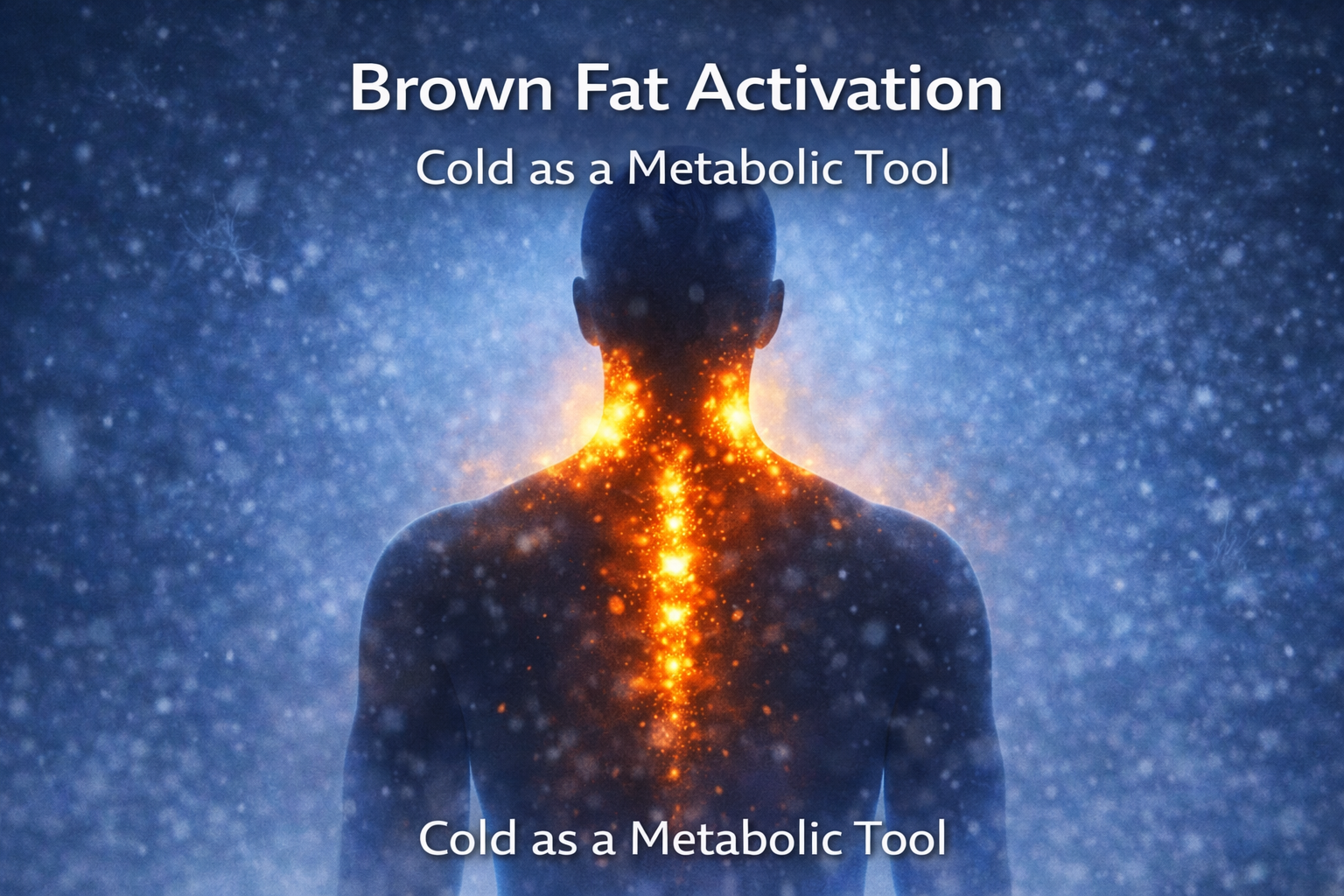
It turns out adults retain brown fat, primarily around the neck, collarbone, and spine. And it’s not vestigial — it’s functional. Under the right conditions, adult brown fat activates and burns calories just like it does in infants.

The discovery reframed how we think about metabolism. Brown fat isn’t just passive tissue. It’s an active metabolic organ that can be recruited, grown, and activated.
The trigger? Cold.
How Brown Fat Works
Brown fat gets its color from mitochondria — the cellular power plants that convert fuel into energy. White fat cells have few mitochondria. Brown fat cells are packed with them.
But here’s the key difference: brown fat mitochondria contain a protein called UCP1 (uncoupling protein 1) that allows them to generate heat instead of ATP. Normal cellular metabolism produces ATP — usable energy. Brown fat metabolism produces heat directly.
This is called non-shivering thermogenesis. Your body burns calories to warm itself without the muscular contractions of shivering.
When you get cold:
- Thermoreceptors in your skin detect the temperature drop
- Your sympathetic nervous system activates
- Norepinephrine is released
- Norepinephrine binds to receptors on brown fat cells
- UCP1 activates and mitochondria start burning fuel for heat
- Glucose and fatty acids are pulled from your bloodstream to fuel the process
You’re literally burning calories to stay warm. And unlike shivering — which is uncomfortable and hard to sustain — non-shivering thermogenesis can run in the background once your brown fat is trained.
Why This Matters for Metabolism
Brown fat activation has several downstream metabolic benefits:
Increased energy expenditure. Active brown fat burns calories. Studies show cold-activated brown fat can increase resting metabolic rate by 10-15% in some individuals. That’s not trivial — over time, it adds up.
Improved glucose uptake. Brown fat pulls glucose from your bloodstream to fuel thermogenesis. Regular activation improves insulin sensitivity and glucose disposal. One study found cold exposure improved insulin sensitivity by approximately 20%.
Better lipid metabolism. Brown fat also burns fatty acids. Regular activation improves triglyceride clearance and lipid profiles.

Protection against metabolic disease. People with more active brown fat have lower rates of obesity, type 2 diabetes, and cardiovascular disease. The correlation is strong and consistent across studies.
This doesn’t mean cold exposure is a weight loss shortcut. The calorie burn from brown fat, while real, isn’t enormous — maybe 100-200 extra calories on a cold day. But the metabolic improvements extend beyond raw calorie burn. You’re improving how your body handles fuel at a fundamental level.
Cold Exposure Grows Brown Fat
Here’s what gets interesting: brown fat isn’t fixed. You can grow more of it.
Regular cold exposure triggers a process called “browning” or “beiging” — white fat cells can be converted into brown-like cells (called beige fat) that share similar thermogenic properties. Your existing brown fat also becomes more active and efficient with regular use.
Studies on winter swimmers show significantly higher brown fat activity compared to non-swimmers. The adaptation happens over weeks and months of consistent exposure. You’re not just activating what you have — you’re building more metabolic machinery.
Dr. Susanna Søberg’s research on winter swimmers found that regular cold exposure led to:
- Increased brown fat volume
- Enhanced cold-induced thermogenesis
- Improved metabolic markers
- Greater calorie burn in response to cold
The subjects weren’t doing anything extreme. Regular cold water swimming — the kind Scandinavians have done for generations — was enough to measurably change their metabolism.
The Søberg Insight: End on Cold
Remember the “end on cold” principle from Post 4? This is where it matters most.
When you get cold, your body activates brown fat to warm itself. If you immediately jump into a hot shower, you’re providing external heat — your body doesn’t need to generate its own. The thermogenic stimulus gets cut short.
By ending on cold and letting your body rewarm naturally, you extend the period of active thermogenesis. More brown fat activation. More metabolic benefit. More adaptation over time.
This is why Søberg specifically recommends finishing contrast therapy sessions with cold rather than hot. The sauna provides the heat stress benefits. The cold provides the metabolic activation. Ending on cold lets your body do the work of rewarming.
You don’t need to shiver for an hour. Just avoid immediately blasting hot water. Put on clothes, move around, drink something warm — let your internal furnace run.
What Temperature Activates Brown Fat?
Brown fat activation isn’t binary — it exists on a spectrum based on cold intensity and duration.
Mild cold (65-70°F / 18-21°C ambient): Begins to activate brown fat, but weakly. Extended exposure needed for meaningful effect.
Moderate cold (60-65°F / 15-18°C ambient): Stronger activation. This is roughly “cool room” temperature — uncomfortable in shorts and a t-shirt.
Cold water immersion (50-60°F / 10-15°C): Strong activation. Water conducts heat away from your body 25 times faster than air, making water immersion far more effective than cold air.
Very cold water (<50°F / <10°C): Maximum activation, but increased safety risks. Shorter exposures required.
For practical brown fat training, cold water in the 50-60°F range for 2-4 minutes is the sweet spot. Cold enough to trigger strong activation, manageable enough to do consistently.
TempRx calculates your BAT (brown adipose tissue) activation level based on temperature, duration, and body coverage. The goal isn’t to maximize any single session — it’s to accumulate enough cold stimulus over time to drive adaptation.
The Long Game
Brown fat adaptation is a long game. You won’t feel dramatically different after one cold plunge. But over weeks and months of consistent practice:
- Your tolerance to cold increases (less discomfort, faster adaptation)
- Your brown fat volume and activity increases
- Your metabolic response to cold becomes more efficient
- Your baseline metabolic health markers improve
Studies typically show measurable changes after 2-4 weeks of regular cold exposure, with continued improvement over months.
This is why the Søberg protocol emphasizes weekly minimums rather than occasional heroic sessions. Eleven minutes per week, every week, for months — that’s what builds brown fat. A single 30-minute ice bath followed by two weeks off doesn’t.
The Takeaway
Brown fat is your body’s built-in furnace. Cold exposure activates it. Regular cold exposure grows it.
The metabolic benefits are real: improved insulin sensitivity, better glucose and lipid handling, increased energy expenditure, and protection against metabolic disease. These aren’t theoretical — they show up in blood work and body composition over time.
But brown fat adaptation requires consistency. Short, regular cold exposures. Ending on cold to maximize thermogenesis. Weeks and months of practice, not one-off stunts.
Your metabolism isn’t fixed. Cold is the lever that changes it.
Next up: Steam Rooms & Hot Tubs — do they count? Lower temperatures, higher humidity, and how to adjust your expectations.
References:
- van Marken Lichtenbelt, W.D., et al. (2009). Cold-activated brown adipose tissue in healthy men. New England Journal of Medicine. https://www.nejm.org/doi/full/10.1056/NEJMoa0808718
- Virtanen, K.A., et al. (2009). Functional brown adipose tissue in healthy adults. New England Journal of Medicine. https://www.nejm.org/doi/full/10.1056/NEJMoa0808949
- Cypess, A.M., et al. (2009). Identification and importance of brown adipose tissue in adult humans. New England Journal of Medicine. https://www.nejm.org/doi/full/10.1056/NEJMoa0810780
- Søberg, S., et al. (2021). Altered brown fat thermoregulation and enhanced cold-induced thermogenesis in young, healthy, winter-swimming men. Cell Reports Medicine. https://www.cell.com/cell-reports-medicine/fulltext/S2666-3791(21)00266-4
- Hanssen, M.J., et al. (2015). Short-term cold acclimation improves insulin sensitivity in patients with type 2 diabetes mellitus. Nature Medicine. https://www.nature.com/articles/nm.3891
- Blondin, D.P., et al. (2014). Increased brown adipose tissue oxidative capacity in cold-acclimated humans. Journal of Clinical Endocrinology & Metabolism. https://academic.oup.com/jcem/article/99/3/E438/2537279
- Ouellet, V., et al. (2012). Brown adipose tissue oxidative metabolism contributes to energy expenditure during acute cold exposure in humans. Journal of Clinical Investigation. https://www.jci.org/articles/view/60433